
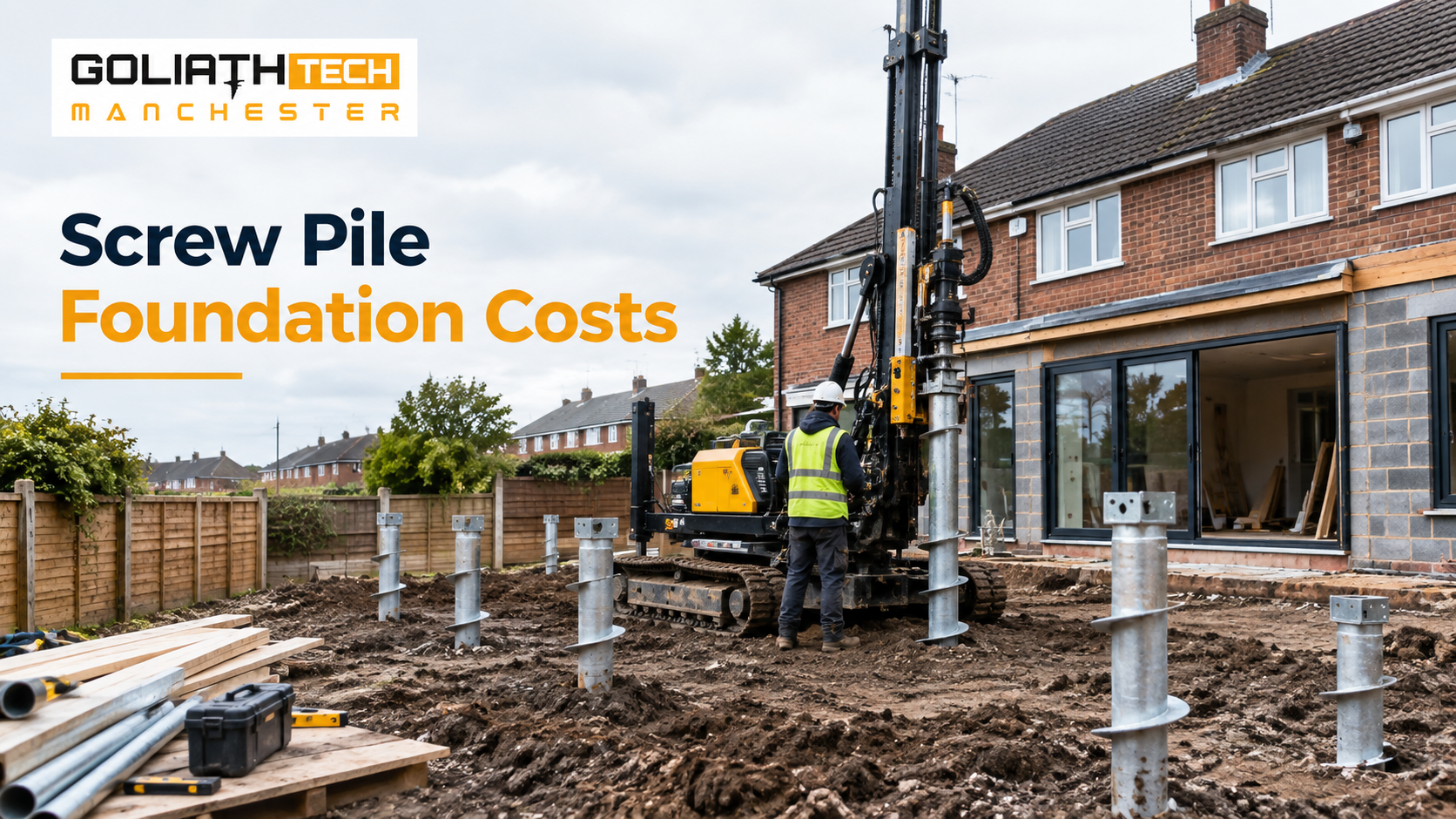
There’s no single price, and any firm that gives you one without seeing your plans and your ground is guessing. What you can work with is a range. UK piling guides put screw piling at roughly £100 to £200 per metre of pile, installed. A traditional foundation for a single-storey rear extension typically comes in at about £3,000 to £8,500 depending on the source. Screw piles aren’t automatically cheaper than trench fill on that line alone. They tend to earn their keep on awkward ground, on time, and on site disruption.
The short answer
- Installed screw piling: about £100 to £200 per metre of pile in one UK piling firm’s current guide, and about £90 to £180 in a UK cost calculator.
- Supply only: roughly £35 to £350 per pile for the steel itself, depending on length and size. That is not an installed price.
- Traditional extension foundations: about £3,000 to £8,500 for a typical single-storey rear extension, depending on the guide and the ground.
- Your price: set by the number of piles and their depth, which your engineer decides from the loads and the ground.
Why the prices you find online don’t match
Search for screw pile costs and you’ll see figures per pile, per metre, per square metre and as lump sums. They aren’t measuring the same thing.
- Per pile (supply only). A supplier such as UK Helix lists piles from about £35 for a short decking pile to about £350 for a lead pile. That’s the steel, not the design, labour or machine.
- Per metre installed. Metro Piling gives £100 to £200 per metre for screw piles, and a UK piling calculator gives about £90 to £180. This is the closest thing to a like-for-like rate.
- Per square metre of extension. An older Checkatrade guide puts a 3m by 7m extension at £4,500 to £8,000 for mini piling, roughly £300 per square metre. That’s a different pile type, and the figure includes the slab.
When you compare quotes, ask for an installed, designed price for your specific extension. Anything else isn’t comparable.
A worked example
This is illustrative arithmetic, not a quote. Say your engineer’s design calls for 12 piles averaging 3 metres deep. That’s 36 metres of pile. At the published £100 to £200 per metre, the piles come to about £3,600 to £7,200.
The pile count and depth here are assumptions. Your engineer sets the real ones. And the piles aren’t the whole job. You’ll also need to allow for:
- Ground beams or pile caps that carry the walls
- The structural engineer’s design, if it isn’t included
- Building control fees and any ground investigation or coal mining search
- Mobilisation of the rig, which small jobs can feel more
For a reality check, one self-builder on BuildHub reported £12,500 for 26 screw piles including design, supply and installation, about £480 a pile all in. It was a different project at a different time, but it shows why the all-in price per pile sits well above the price of the steel.
How that compares with trench fill
Published ranges for traditional foundations on a single-storey rear extension include:
- About £4,000 to £7,000 (MyJobQuote, January 2026)
- About £3,000 to £8,000 for strip and £3,500 to £8,500 for trench fill on a 20 to 30 square metre footprint (Trade2Base, June 2026)
- About £3,000 to £5,500 for strip and £3,600 to £6,000 for trench fill (MyBuilder)
Those figures assume reasonable ground. They climb quickly when it isn’t. Trade2Base notes that a mature oak eight metres from an extension can push foundation depths to two or three metres, which puts the cost in mini pile territory rather than standard strip.
So where do screw piles save money, and where don’t they?
Where they tend to save:
- No trench excavation and no spoil to skip or cart away
- No concrete delivery or curing wait, so the next trade starts sooner and weather costs less
- Compact kit that reaches back gardens and side returns a digger and lorry can’t
- Shallower, quicker work near trees than a deep trench
Where they don’t:
- On good, open ground a shallow trench fill foundation is hard to beat on the foundation line alone
- Very hard or obstructed ground, such as boulders or rock, can limit what screw piles can do
- You still pay for engineering, ground beams and building control
The honest comparison is total job cost and programme, not the foundation line in isolation. Our guides on screw piles versus concrete foundations and screw piles versus driven piles go further on the trade-offs, and what drives foundation costs in general is covered separately.
What pushes the price up or down
- Number of piles. Driven by the loads. A masonry extension with a heavy roof needs more than a lightweight timber frame.
- Depth to firm ground. Deeper means more metres, and one self-builder reported being charged by the linear metre beyond a set depth.
- The ground. Clay, made ground and nearby trees all change the design.
- Access. Tight access can add time, but it can also be where screw piles beat the alternatives.
- Floor and wall build-up. The floor slab or beam and block choice changes the total, as the Checkatrade guide notes.
- What the price includes. Design, testing, ground beams and paperwork.
Greater Manchester ground and your budget
Much of the region sits on clay-rich glacial deposits, and former industrial sites often have made ground. Parts of Wigan, St Helens, Oldham and Manchester sit over the South Lancashire Coalfield, so a coal mining report for your address is a sensible early step and can affect the design. If you’re building in Manchester, Stockport, Bolton or Wigan, that local ground information is worth having before you compare prices.
How to get a quote you can compare
- Is the price installed, and does it include the engineer’s design and calculations?
- How many piles and what depth is it based on, and what’s the rate per extra metre if the ground is deeper?
- Are ground beams or pile caps included?
- Will you get installation records for every pile?
- Who deals with building control, and is that included?
- Is VAT included, and what does the warranty cover?
If a quote can’t answer these, you can’t compare it with another.
Conclusion
Screw pile foundations for a UK extension are priced by the metre of pile installed, and the realistic range depends on how many piles you need and how deep they go. They’re not automatically cheaper than concrete, but they often win on awkward ground, speed and disruption. Compare installed, designed prices, and be wary of any number quoted before someone has looked at your plans and your ground.
Planning an extension in Greater Manchester? Ask for a free estimate. Call +44 161 66 00 445 or get in touch through our contact page. Every installation carries a manufacturer-backed Limited Lifetime Warranty.
FAQ
How much do screw piles cost per pile?
Supply-only prices run from about £35 to £350 per pile depending on length and size. The installed price is better judged per metre, which UK guides put at roughly £100 to £200, and it depends on the design and the ground.
Are screw piles cheaper than concrete foundations for an extension?
Not automatically. On good, open ground a trench fill foundation can be cheaper on its own line. Screw piles tend to compete on awkward ground, speed, access and reduced groundworks, so compare the total job.
How many screw piles does an extension need?
It depends on the loads, the pile size and the ground, so your structural engineer sets it. Anyone quoting a number without your plans is estimating.
What should a screw pile quote include?
Look for the engineer’s design, the pile count and depth assumed, the rate for extra depth, ground beams or pile caps, installation records, building control liaison, VAT and the warranty terms.
Do screw piles save money on groundworks?
They can. There’s no trench to dig, no spoil to remove and no concrete to cure, which cuts excavation, disposal and waiting time. The saving varies with the site.
Does a screw pile foundation need building regulations approval?
For an extension, yes. The foundations are part of the work, and building control will expect an engineered design.