
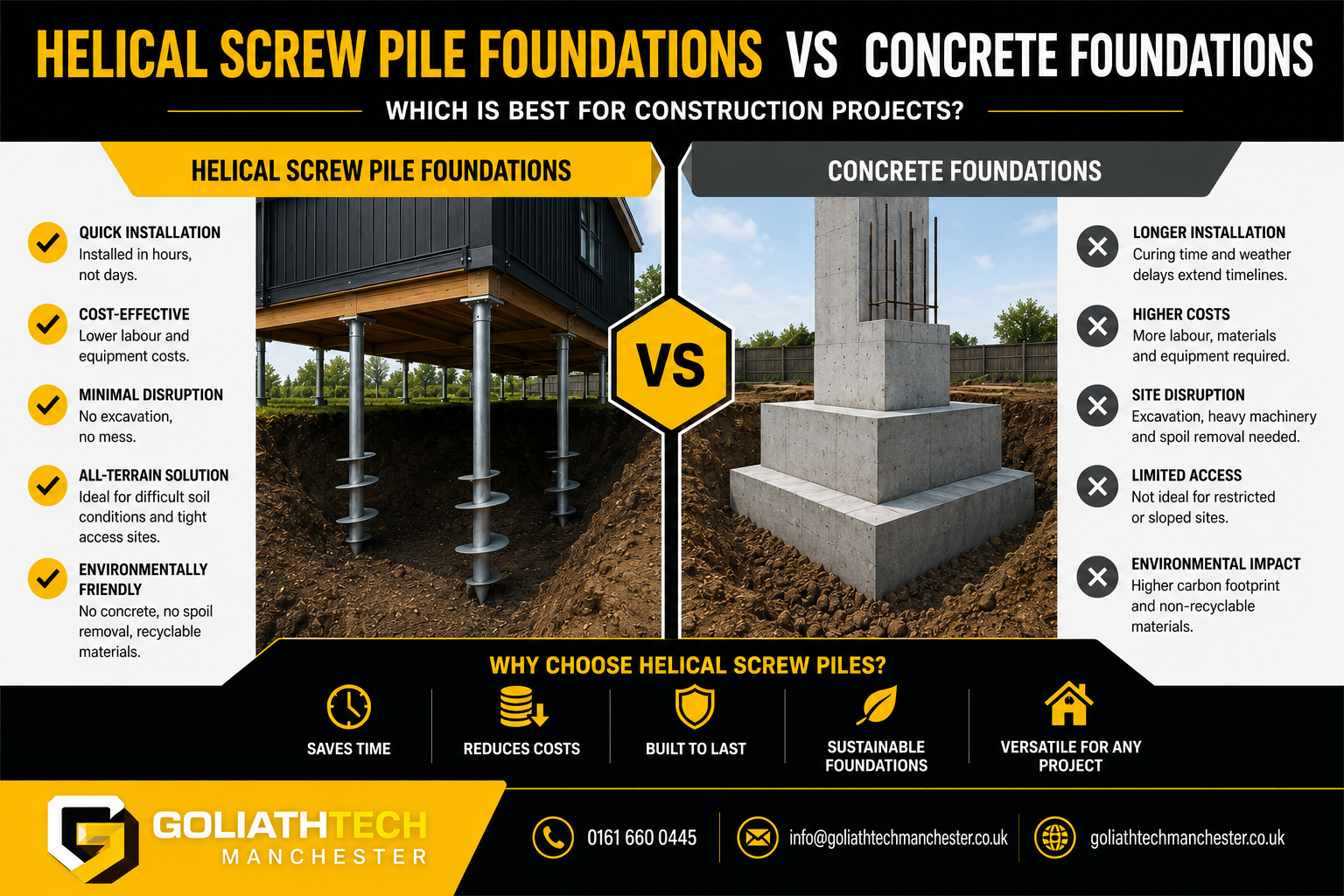
Selecting the appropriate foundation is a vital part of any construction project. All building projects start with a good foundation. Whether it is a home extension, commercial building, deck, water tank, industrial installation, EV charger, solar ground mount system, or a simple sign installation. The right foundation is key to long-term stability and durability.
Concrete foundations have been used extensively for decades. Today, Helical Screw Pile foundations are a popular and modern alternative across Manchester / Greater Manchester / North. They are constructed much faster than normal concrete foundations. They also cause less disturbance on the job site.
Understanding the differences in these foundation systems is important. It assists you in choosing the best solution for your project. In this guide, GoliathTech Manchester is going to discuss the major differences between Helical Screw Piles and concrete foundations. It also covers their advantages, disadvantages, and typical applications.
What are Helical Screw Pile Foundations?
Helical Screw Pile foundations are built by driving steel piles deep into the ground. These piles provide a solid, stable base for the structure above.
Helical Screw Piles do not require digging, formwork, steel reinforcement, or curing time like concrete footings.
How Do Helical Screw Piles Work?
Installation is pretty simple:
- Site evaluation and engineering review
- Marking of pile layout.
- Hydraulic installation equipment drills piles into the ground.
- Torque readings are confirming load capacities.
- Brackets or pile caps are fixed.
- Construction can commence immediately.
As load capacity is checked on installation. Foundation performance is confirmed in real time by engineers.
What is a concrete foundation?
Concrete foundations transfer the structural loads to the ground. They do this through spread footings, strip foundations, slabs, or reinforced concrete systems.
Structural loads cannot be applied until the ground has been excavated. The reinforcement must be placed first, followed by pouring the concrete. The concrete then needs time to cure before any load can be applied.
Normal Concrete Foundation Process:
- Excavation
- Soil preparation
- Formwork Erection
- Placement of reinforcement
- Concrete placement
- Cure time
- Construction starts
The process is very effective, but it often adds a lot of time to the project compared to Helical Screw Pile installation.
Helical Screw Pile Foundations vs Concrete Foundations: Key Differences
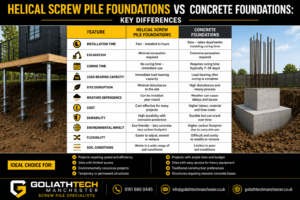
If you are deciding between Helical Screw Piles and concrete foundations. The right choice depends on your site conditions, project timeline, and goals.
Both systems can offer reliable structural support, but in different ways. Each one has its own advantages too.
Installation time
One of the first things contractors notice is the difference in installation time.
Helical Screw Piles can generally be installed in minutes; a complete site can be completed in just a few hours (Conditions and limitations apply). There is no curing period, so normally construction can start right away. If using concrete foundations, the process takes longer. Excavation, reinforcement, pouring, curing, etc., take time. Which can extend a project schedule by days or weeks.
Excavation and Site Disturbance
Traditionally, concrete foundations involve digging trenches or footings. This also requires soil removal and the import of materials and machinery. It can make for a muddy, noisy, and difficult-to-navigate site.
Helical Screw Piles are far less intrusive. They are screwed into the ground with minimal or No excavation. This makes them a popular choice for landscaped gardens, properties, and other areas. “It is important for us to preserve the environment around us.
Weight Bearing
Both foundation systems can support large loads if designed properly.
One of the big advantages of Helical Screw Piles is the ability to confirm capacity at installation. This is done by measuring the torque. This provides engineers with instant feedback on performance. Concrete foundations are not at full strength until the concrete has cured.
Weather Reliance
If you’ve worked on a site in Manchester / Greater Manchester / North, you know how the weather can turn.
Heavy rain can delay the digging and pouring of concrete. The cure is slowed by cold temperatures. Helical Screw Piles are less sensitive to weather delays. Because they don’t use poured concrete.
Environmental Effects
As construction becomes more sustainable. A lot of developers are trying to reduce waste and use less material.
Helical Screw Pile systems generally involve less excavation and significantly less concrete. This can help to reduce the environmental impact of a project. They also create less spoil to truck away.
Access to Restrictive Sites
Open access isn’t available for all projects. For rear gardens, tight urban plots, school grounds, or sites in the middle of existing buildings. Helical Screw Piles can usually be installed with compact equipment. That makes them particularly useful in places where larger excavators would find it hard to operate.
Performance in difficult ground conditions
Ground conditions are very different across Manchester / Greater Manchester and North. Often, construction is hampered by clay, made ground, and high groundwater.
Helical Screw Piles are effective in these conditions because they transfer loads to deeper, more stable, and stronger soil layers.
Concrete foundations will work too. But they usually need more extensive digging or further engineering to reach the same level of performance.
Summary
Here are some of the reasons Helical Screw Piles are a great option for many residential and commercial projects:
- Quicker installation
- Little digging
- Immediate load-bearing capacity
- Fewer weather-related delays
- Less disruption on site.
- Better access to restricted areas
- Lower environmental impact
While concrete foundations are still a choice for many projects. Helical Screw Pile systems are becoming more popular. They are often chosen when speed, efficiency, and site conditions are paramount. And just for Manchester / Greater Manchester / North citizens, it’s good news that GoliathTech offers reliable and affordable Helical Screw Piles installation services.
Why Manchester / Greater Manchester / North Soil Conditions Matter
Manchester / Greater Manchester / North presents unique foundation challenges.
Across Manchester / Greater Manchester / North, soil profiles commonly include:
- Glacial till
- Clay soils
- Made ground
- Variable fill materials
- Areas with elevated groundwater
- Former industrial land
These conditions can create risks for shallow concrete foundations. Where settlement, shrink-swell clay behaviour, or poor bearing capacity exists.
Why Screw Foundation Piles Perform Well
When the foundation is supported on screw foundation piles. The load is transferred to deeper, more stable bearing layers instead of near-surface soils.
This approach can:
- Reduce settlement risks
- Improve performance in clay soils.
- Minimise excavation requirements
- Avoid removing large volumes of spoil.
- Provide a predictable foundation capacity.
This makes them particularly valuable for many Manchester / Greater Manchester / North construction projects.
Benefits of Helical Screw Pile Foundation Installation
- Faster Construction Programmes
One of the biggest advantages is speed.
Traditional concrete foundations require:
- Deep Excavation
- Reinforcement installation
- Concrete delivery
- Curing periods
By contrast, Helical Screw Pile foundation installation often allows construction to begin immediately after installation.
For commercial projects, this can significantly reduce programme durations.
- Minimal Site Disruption
Urban sites have restricted access.
Helical Screw Piles are ideal for:
- Back gardens
- Schools
- Parks
- Existing buildings
- Commercial developments
- New Homes / dwellings
- Solar Ground Mount Systems
- Underpinning Jobs
- City-Centre projects
Because excavation is limited, landscaping and surrounding infrastructure experience far less disruption.
- Less Impact on the Environment
More and more importance is being given to sustainable construction.
Against concrete foundations, Helical Screw Piles can help to reduce:
- Excavated spoil
- Concrete use
- Waste on site
- Vehicle traffic
- Greenhouse gas emissions
Many developers today view Helical Screw Piles as an environmentally responsible foundation solution.
- Performance in Challenging Ground Conditions
Helical piles excel where:
- Clay soils are present.
- Groundwater levels are high.
- Sites are sloping
- Fill materials exist
- Bearing capacity varies
Instead of relying on shallow soil layers, piles can extend deeper into competent strata.
- Year-Round Installation
Manchester / Greater Manchester / North weather is rarely predictable.
Heavy rain can delay concrete works.
Helical Screw Piles are less dependent on weather conditions because they don’t need concrete curing.
This allows projects to continue throughout the year.
When Concrete Foundations May Be Better
Although Helical Screw Piles offer many advantages, concrete remains appropriate in certain situations.
Concrete May Be Preferred For:
- Extremely high structural loads
- Specific engineering requirements
- Certain ground conditions involving shallow rock
Foundation selection should always follow engineering review and geotechnical assessment.
Common Applications for Helical Screw Pile Foundations
Residential Construction
Homeowners increasingly choose Helical Screw Piles for:
- House extensions
- Garden rooms
- Conservatories
- New-build homes
- Foundation repairs
- Structural underpinning
Many home foundation contractors UK-wide are now incorporating helical pile solutions into residential projects.
Commercial Construction
Commercial applications include:
- Warehouses
- Modular buildings
- Retail developments
- Office expansions
- Telecom infrastructure
- Industrial facilities
Deep pile foundation services provide reliable support while minimising disruption to operations.
Signage Foundations
Large signs and billboards generate substantial wind loads.
Helical Screw Piles are used because they offer:
- Fast installation
- Strong uplift resistance
- Reduced excavation
- Easier replacement and upgrades
Common Mistakes When Choosing a Foundation System
The cheapest foundation option upfront is not always the most long-term.
Consider:
- Construction delays
- Labour costs
- Site restoration
- Equipment requirements
- Future maintenance
Ignoring Ground Conditions
Every site is different.
A geotechnical assessment helps determine:
- Soil type
- Bearing capacity
- Groundwater conditions
- Potential settlement risks
Not Using Engineered Designs
Foundations should never be selected without engineering input.
Proper design ensures:
- Structural safety
- Regulatory compliance
- Long-term performance
Expert View: What We See Across Manchester / Greater Manchester / North
At Goliathtech Manchester / Greater Manchester / North, one trend is clear.
There is a growing focus among property owners, developers, contractors, and engineers. They are paying more attention to speed, sustainability, and reliable foundation performance.
Today, many projects that were once built using traditional concrete systems are now using helical piles.
- Shorten project schedules
- Reduced site disturbance
- Enhance access flexibility
- Lifting capacity confirmed.
Helical Screw Piles are often a practical alternative to conventional foundations. They are used for projects such as extensions, decks, and commercial developments.
FAQ
Are Helical Screw Piles better than a concrete foundation?
Both can be excellent structural supports when engineered. The optimum choice will be dependent on load requirements and site conditions.
Can you install Helical Screw Piles in the winter?
Yes. Installation can usually be performed year-round.
Do Helical Screw Piles require concrete?
Concrete is not needed for many applications.
Can Helical Screw Piles be used in clay soils in Manchester / Greater Manchester / North?
Yeah, they are used where clay-rich conditions prevail, as loads may then be transferred to deeper bearing layers.
Can Helical Screw Piles be installed under commercial buildings?
Yes. Engineered helical pile systems are frequently used in commercial construction.
Are Helical Screw Piles environmentally friendly?
They are less disruptive and require less material than ordinary concrete foundations.
How long does it take to install a Helical Screw Pile foundation?
Many projects can be completed in a single day depending on the scale.
Conclusion: Concrete Foundations vs Helical Screw Pile Foundations
Comparing helical screw pile foundations to concrete foundations. No one answer fits all.
Concrete still provides a proven method of foundation for many structural applications. But there are clear advantages to modern helical screw pile systems. This includes faster installation, improved sustainability, easier site access, and reduced excavation. They are also good at testing ground conditions.
Get in touch with Goliathtech Manchester / Greater Manchester / North.
If you are planning a building project and need expert advice on the best foundation solution for you, Goliathtech Manchester / Greater Manchester / North can help you.
Our team’s areas of expertise are:
- Helical Piers
- Piles, screwed
- Service of deep pile foundation
- Business locations
- House foundations
- Signage bases
- Parks and school infrastructure
- Deck foundations
- Support systems in structures
Call Goliathtech Manchester / Greater Manchester / North today to discuss your project and get expert foundation advice for your site conditions and structural requirements.