
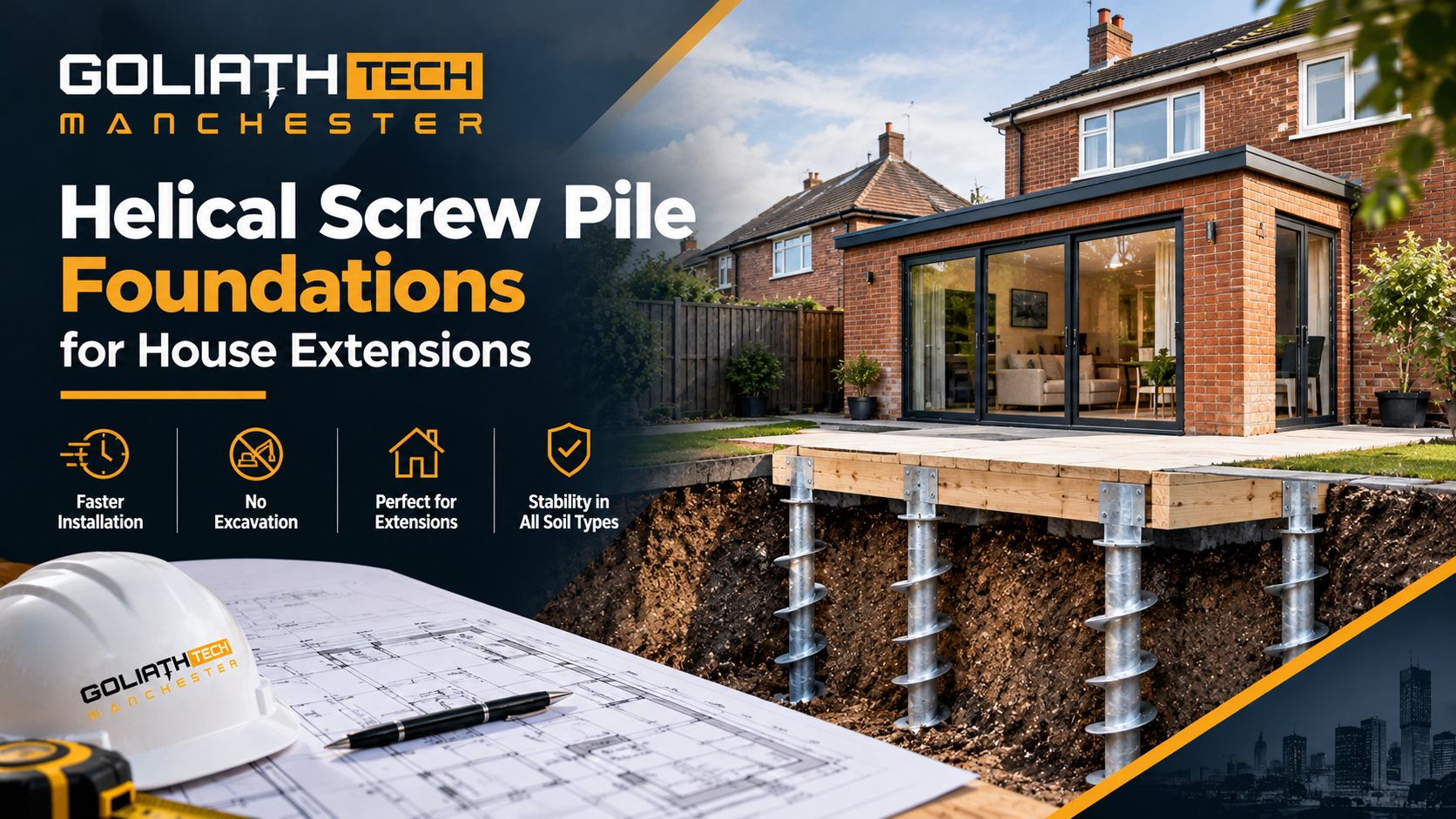
Most extension projects in Greater Manchester stall at the foundation stage. The ground is soft, or the access is too tight for a concrete lorry, or building control wants deeper footings than anyone budgeted for. Helical Screw pile foundations solve all three problems without adding weeks to the programme. This page covers how they work for extensions, what they cost, how ground conditions vary across the region, and which areas GoliathTech Manchester currently covers.
Table of Contents
Why helical screw piles work well for house extensions
A rear extension on a typical Greater Manchester semi comes with several ground-related complications that rarely show up until someone starts digging. Clay soil shrinks and swells seasonally. Tree roots from a neighbour’s oak or your own garden can push traditional strip foundations deeper than the original design assumed. A side return is often too narrow for a digger. Made ground from previous building work can make concrete depth unpredictable.
Helical Screw piles deal with each of these without changing the programme. The installation rig is compact enough to work in a side return or a narrow back yard. The piles go past the clay active zone to stable ground below, which removes the seasonal movement risk. There is no excavation and no spoil to remove, which matters a great deal on an occupied residential site where the garden is the only access route.
The other practical point is time. A concrete strip or trench fill foundation poured in October in Manchester is not going to be ready for a week, and if it rains, longer. A helical screw pile installation is load bearing the same afternoon. Your builder starts the next morning regardless of what the weather did the day before.
GoliathTech’s system carries a manufacturer-backed Limited Lifetime Warranty and is accepted under the NHBC scheme.
What the installation actually involves
Before anything goes into the ground, the structural engineer confirms the pile layout, diameter, helix configuration, and target depth. That design is based on the structural loads your extension puts on the foundation and the ground conditions at your specific site. Two houses on the same street can need different pile depths if the made ground depth varies between them.
On installation day, the rig drives each pile to the specified depth. The torque reading at the end of each pile is logged. That log is what demonstrates the load capacity was achieved, which is what building control and your structural warranty provider will want to see.
There is no concrete on site. There is no spoil to remove. The piles go in, the connection detail is set up for your builder, and the site is ready. For a typical single-storey rear extension, the full installation usually takes one day.
After the piles, your builder installs the ground beams or pile caps that connect the piles to the wall structure. This is standard groundworks that any competent builder handles. The helical screw pile contractor installs the piles and provides the installation records. Everything above that is your builder’s scope.
What it costs
There is no fixed price for helical screw pile foundations on a house extension, and any figure you see without a site assessment behind it is an estimate at best.
UK industry sources put installed screw piling at roughly £100 to £200 per linear metre of pile. The number of piles and their depth is determined by the structural engineer based on your loads and ground. A typical single-storey rear extension might need ten to fourteen piles at two to three metres depth depending on where the stable bearing layer sits. That gives a rough pile installation range of around £2,000 to £8,400 before ground beams, structural design, and building control fees.
What changes the total:
- Depth to stable ground. Clay-heavy areas like parts of Stockport and Cheadle can mean deeper piles to get below the active zone. Made ground in Salford and central Manchester varies in depth from site to site.
- Whether structural design is included. Some contractors quote supply and install only. The engineer’s design fee sits on top.
- Access. A side return or back yard with a single gate is slower to work in than an open rear garden. It is still faster than getting concrete in and out.
- Ground beams. The piles are not the complete foundation. Ground beams connecting the piles to the wall structure are a separate item in the build programme.
The honest comparison is total job cost, not the foundation line in isolation. On difficult ground, helical screw piles regularly save money on the overall groundworks even when the pile installation costs more per day than a concrete pour would. You can read more about how the numbers compare in our guide on helical screw piles versus concrete foundations.
Ground conditions across Greater Manchester
Ground conditions vary considerably across the region and they affect both the pile specification and the cost. Here is what we typically encounter across the areas we work in.
Manchester and Salford. Made ground is common in central areas, often over Triassic sandstone at variable depth. Obstructions from previous structures turn up regularly. Pile depth to stable bearing material can vary by a metre or more between adjacent plots. If you are building a home addition in Manchester or a rear extension in Salford, a site-specific ground assessment before committing to a foundation design saves time and money later.
Stockport and Cheadle. Glacial till with boulder clay is the dominant soil type across much of this area. The clay active zone can extend to 900mm or deeper near trees. Rock head appears closer to the surface in some parts of Stockport and Cheadle than in other parts of the region, which affects pile depth.
Bolton and Wigan. Parts of this area sit over the South Lancashire Coalfield. A coal mining report for your address is worth obtaining before a foundation design is finalised, as mine workings at depth can affect what is specified. For extensions in Bolton and Wigan, this is a routine check that any competent contractor will flag.
Oldham and Rochdale. Carboniferous gritstone sits closer to the surface in parts of Oldham and Rochdale than in the lowland parts of Greater Manchester. This can limit pile depth but also means the stable bearing layer is not far down.
Warrington, Altrincham, and Sale. Softer alluvial and river terrace deposits are more common in the western and southern parts of the region. Extensions in Warrington, Altrincham, and Sale often benefit from helical screw piles precisely because soft ground makes traditional strip foundations unpredictable.
Wilmslow, Knutsford, and Alderley Edge. The Cheshire Plain to the south of Manchester has softer, silty clays in places. Extensions in Wilmslow, Knutsford, and Alderley Edge on lower-lying plots often need pile depths that would push concrete foundations into expensive territory.
NHBC approval and building control
A house extension needs building regulations approval. The foundation system is part of the structural design submission, and building control will expect to see the engineer’s design and the torque installation records after the work is done.
GoliathTech’s pile system is accepted under the NHBC scheme. This matters most on new builds where mortgage lenders require NHBC sign-off, but it is also relevant for extensions on properties that will be sold in the future. A foundation that building control has signed off against an NHBC-accepted system is cleaner to handle on a future sale than one that required a bespoke warranty arrangement.
Not every helical screw pile system carries NHBC acceptance. If you are getting multiple quotes, ask each contractor which specific pile system they are installing and whether it is accepted under NHBC. A general assurance that the company is registered somewhere is not the same thing.
Areas we cover
GoliathTech Manchester installs helical screw pile foundations for house extensions across Greater Manchester and the surrounding counties. Click your area for local ground condition details and project examples.
Greater Manchester
Salford
Stockport
Bolton
Bury
Oldham
Rochdale
Wigan
Ashton-under-Lyne
Leigh
Sale
Altrincham
Cheadle
Hyde
Stalybridge
Dukinfield
Heywood
Littleborough
Cheshire and Lancashire
Merseyside and Derbyshire
If your location is not listed, contact us. We assess every enquiry individually and cover the wider North West region.
What to ask before you book a contractor
The questions that matter most are not about price. They are about what the price actually covers and whether the contractor knows the ground they are working in.
Is the quote installed, and does it include the structural design? A supply-only price is not comparable with a designed and installed price. Make sure you know which one you are being quoted.
How many piles and at what assumed depth? The pile count and depth drive the cost. If the ground turns out to be deeper than assumed, ask what the rate is for additional metres before you sign.
Are ground beams or pile caps included? They are usually not in a piling-only quote, and your builder needs to know this before pricing the groundworks.
What does the warranty cover? GoliathTech provides a manufacturer-backed Limited Lifetime Warranty on the pile system. Ask any other contractor what warranty applies to the specific system they are installing, not just their workmanship.
Will you get torque installation records? These are your evidence that load capacity was achieved. Building control will ask for them. If a contractor does not mention them, ask why not.
There is more detail on what to check in our full guide on how to choose a helical piling contractor in Greater Manchester.
FAQ
Do helical screw pile foundations need planning permission for a house extension?
The foundation itself does not usually need planning permission. The extension it supports may or may not, depending on its size and your permitted development rights. Building regulations approval is required regardless, and the foundation system is part of that submission.
How long does helical screw pile installation take for a house extension?
Most single-storey rear extension foundations are installed in one day. The site is load bearing the same afternoon. Your builder starts the following morning. There is no curing period.
Can helical screw piles be installed in a narrow side return?
Yes. This is one of the practical advantages over traditional excavation. The installation rig is compact and can work in access conditions that would prevent a digger from operating. A site assessment will confirm whether your specific side return presents any constraints.
What happens if tree roots are found during installation?
Tree roots affect the installation of traditional strip foundations significantly more than helical screw piles. The pile is driven past the root zone to stable ground below. In most cases, roots close to the surface do not prevent installation, though the exact approach depends on root size and proximity. Your site assessment will flag any trees that need consideration in the design.
Are helical screw piles removable after an extension is demolished?
Yes. Helical Screw piles can be extracted after removal of the structure above. This is one difference from concrete foundations, which are permanent once poured. For most domestic extensions this is not a practical consideration, but it is a genuine distinction.
How do I get a quote for a house extension foundation in Greater Manchester?
Contact GoliathTech Manchester for a free site assessment. An engineer visits, checks the ground, and gives you a written recommendation and quote at no charge. Call +44 161 66 00 445 or use our contact page.
Start Your Next Project with a Strong Foundation
Free site assessment across Greater Manchester and the North West. No charge, no obligation.
Phone: +44 161 66 00 445
Email: [email protected]
F32, BizSpace Cheadle, Stockport Road, SK8 2JX