
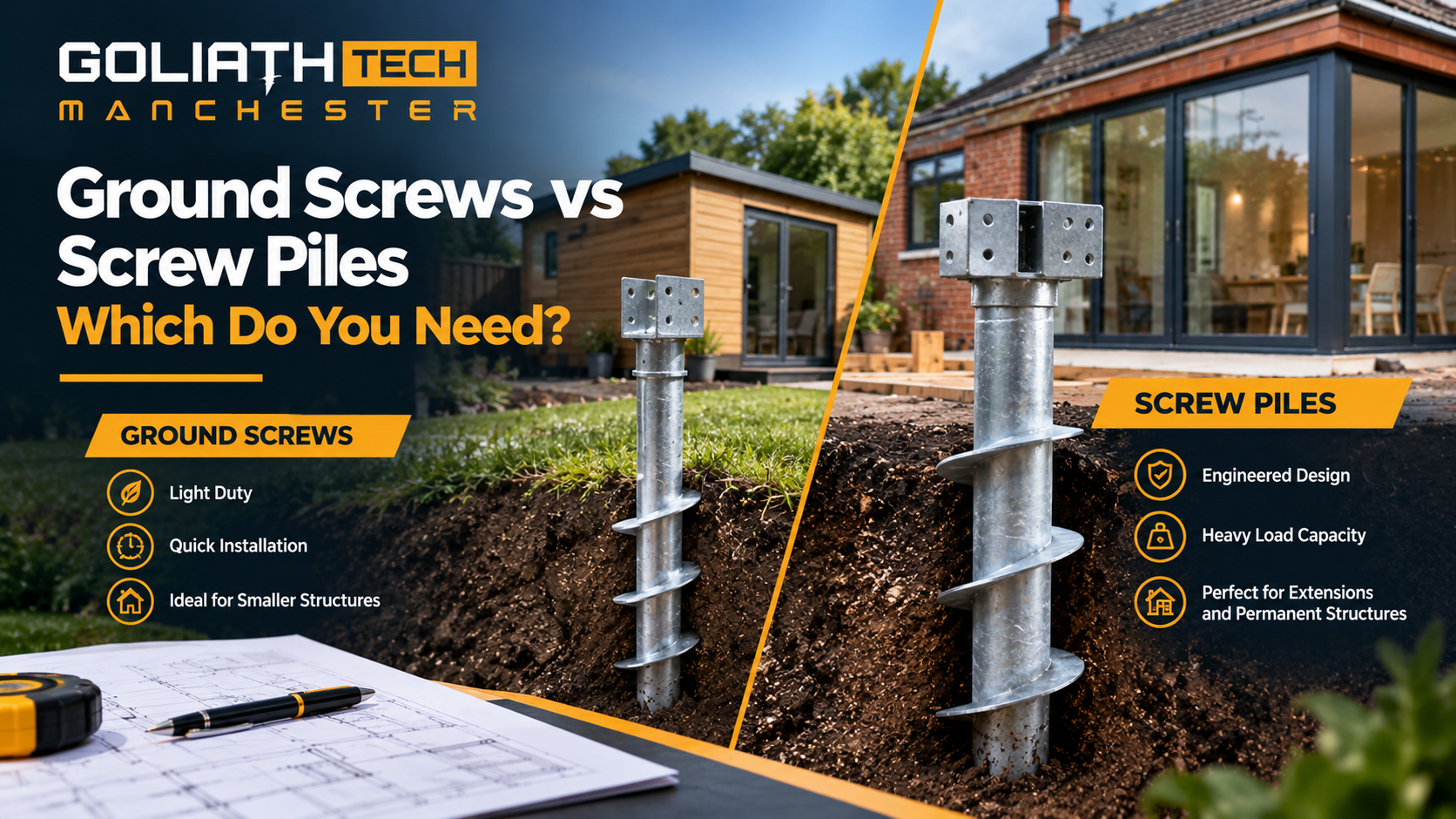
Ground screws and helical screw piles are the same idea at different scales. Both are steel shafts with a helix that’s turned into the ground, and neither needs concrete. “Ground screws” is the name usually given to smaller, lighter-duty screws for garden structures. “Helical screw piles” is the engineering term for larger foundations that are designed for a specific load and a specific site. There’s no hard line between the two. What decides which you need is how much weight the foundation carries, what the ground is like, and who’s responsible for the design.
Table of Contents
- The short answer
- What ground screws are good for
- What helical screw piles are, and where they take over
- Ground screws vs helical screw piles: the differences that matter
- Which should you choose? Common projects
- Do you need building regulations approval?
- Common mistakes
- Ground conditions in Greater Manchester
- How GoliathTech Manchester can help
- Conclusion
- FAQ
The short answer
- Deck, small shed, fence or playhouse: ground screws are often enough, and some suppliers sell kits designed for self-installation.
- Garden room, cabin or summerhouse: it depends on size, weight, the ground and how you’ll use it. Larger or heavier buildings need a proper design.
- House extension, retaining wall, or a building on soft, sloping or made ground: you need engineered screw piles, designed from the loads and the ground.
- Anything near trees, on clay, or with heavy loads: get a professional to specify it.
What ground screws are good for
Ground screws earn their popularity on light structures. UK suppliers market them for decking, sheds, summerhouses, garden offices, fences and play equipment, and some produce lighter-duty screws that a competent DIYer can install with the right driver. There’s no digging, no concrete to mix and no curing wait, so the structure can go on straight away. They also cope well with sloping gardens, because each screw can be set to a different height rather than needing a level excavated base.
There are limits. One UK supplier, FH Brundle, points out that the lighter, DIY-style screws suit decking and lightweight structures, that heavier loads call for professional screws installed by a professional, and that a ground survey is advisable once you’re going deeper than around 1,250mm. Because much of the holding power in lighter screws comes from friction along the shaft, the soil matters a great deal. Loose, soft or made ground can behave very differently from firm clay.
What helical screw piles are, and where they take over
Helical screw piles use the same principle but are sized and specified as a structural foundation. The shaft and helix are larger, the piles usually go deeper to reach firm ground, and the layout is designed from the loads the building puts on them. A geotechnical conference paper on ground screws notes that larger-diameter screws are treated as pile foundations and designed in a similar way to driven steel piles, rather than as a quick garden fix.
That design step is the real dividing line. With a helical screw pile foundation, an engineer works out how many piles, what size and how deep, and each pile is installed to a target depth and installation torque that’s recorded. Those records are what show the pile reached the capacity the design assumed, and they’re what building control and any warranty provider want to see. GoliathTech’s piles are supplied with shaft sizes from about 48mm to 98mm and helix diameters from about 203mm to 330mm, according to our product brochure, so the sizes overlap with the larger end of ground screws. What differs is the engineering around them.
Ground screws vs helical screw piles: the differences that matter
- Load. Ground screws suit light structures such as decks and small sheds. Screw piles are designed for heavier loads such as masonry walls, extensions and retaining walls.
- Design. A ground screw is often chosen from a supplier’s guide or load chart. A screw pile layout is calculated for your building and your ground.
- Ground information. Light screws on firm ground may need little more than a look at the soil. Anything heavier, deeper or on uncertain ground needs proper ground information, such as a trial hole or site investigation.
- Installation. Lighter screws can sometimes be installed by hand or with a small driver. Helical screw piles are installed by a contractor with a hydraulic rig and recorded torque readings.
- Paperwork. A garden deck may need none. An extension needs building regulations approval, and building control will expect an engineered design and installation records.
- Responsibility. With DIY ground screws, you carry the risk if the choice or installation is wrong. With designed screw piles, an engineer and installer stand behind the specification.
Which should you choose? Common projects
Decking and small sheds. Ground screws are often a sensible choice. Check the manufacturer’s load rating and be honest about the ground. If the soil is soft or the deck is high, ask a professional.
Garden rooms, cabins and summerhouses. This is where people get caught out. A small, lightweight timber summerhouse is a different load from a heavily insulated garden office with a green roof and a full interior. If the building is large, heavy, on sloping or soft ground, or close to trees, a designed foundation is safer. See our pages on cabin and cottage footings and sunroom and garden room footings.
Decks and sheds with bigger loads. A hot tub, a workshop with machinery or a heavy storage building needs more than a standard kit. Our pages on decks and sheds cover how these are specified.
House extensions. Use engineered screw piles. The foundations are part of work that needs building regulations approval. Our page on home addition foundations explains the process.
Retaining walls, underpinning and anything structural. These need an engineered design. See retaining walls and underpinning. Our guide on screw piles versus underpinning compares the options.
Do you need building regulations approval?
For a house extension, yes, and the foundations are part of it. For a garden building, it depends. Some small detached buildings are exempt from the building regulations under Schedule 2, as the Planning Portal’s exemptions guide explains. In practice, a detached single-storey building with no sleeping accommodation is generally exempt up to 30 square metres, provided it’s at least one metre from the boundary or built mainly from non-combustible materials. Under 15 square metres the boundary condition doesn’t apply.
If the building is attached to the house, over the size limit, or has anywhere to sleep, it’s back in scope. Even when exempt, the foundation still has to hold the building up. Planning permission is a separate question again, so check both with your local authority before you assume. This guide covers England; rules in Wales can differ.
Common mistakes
- Treating a kit rating as a guarantee. Load ratings assume a ground type. Soft, loose or made ground can perform very differently.
- Ignoring trees and clay. Shrinking and swelling clay near trees is a classic cause of movement, and it’s exactly where a designed foundation earns its keep.
- Underestimating the building. Insulation, a green roof, glass, a full interior and furniture add up. Weigh the finished building, not the empty frame.
- Skipping ground information. A quick probe isn’t a ground investigation.
- Comparing the wrong prices. A supply-only kit price isn’t comparable with a designed and installed price.
- No installation records. If a pile isn’t recorded, you can’t show it reached the capacity the design assumed.
Ground conditions in Greater Manchester
Much of the region sits on clay-rich glacial deposits, and former industrial sites often have made ground. Parts of Wigan, St Helens, Oldham and Manchester sit over the South Lancashire Coalfield, so a coal mining report for your address is a sensible early step on any build. These are the conditions where the difference between a quick ground screw and a designed screw pile matters most. If you’re searching for ground screws in Manchester, Stockport, Salford or Wigan, start by finding out what’s under your plot.
How GoliathTech Manchester can help
Our work is led by a Chartered Engineer, and our helical pile system is accepted under the NHBC Accepts scheme. NHBC Accepts is NHBC’s review of a system against its own standards, not a performance guarantee, so every project still needs its own design and, where it applies, building control sign-off. Our compliance page lists the certifications behind the system, and installations carry a manufacturer-backed Limited Lifetime Warranty. If you’ve read our guide to common screw pile myths, you’ll know we’re open about where screw piles do and don’t suit a job.
Conclusion
Ground screws are a good answer for light garden structures on sound ground. When the load gets heavier, the ground gets less certain or the work falls under building regulations, you’re in screw pile territory, and the design matters more than the product name. If you’re not sure which side your project falls on, ask someone to look at it before you buy.
Planning a garden room, extension or retaining wall in Greater Manchester? Ask for a free estimate and we’ll tell you what your plot needs. Call +44 161 66 00 445 or get in touch through our contact page.
FAQ
Are ground screws and screw piles the same thing?
They work on the same principle: a steel shaft with a helix turned into the ground. “Ground screws” usually means smaller, lighter-duty screws for garden structures, while “screw piles” means larger foundations designed for a specific load and site.
Can ground screws be used for a garden room?
Sometimes. A small, light garden room on firm ground may suit them, but a large, heavy or insulated building, or one on soft, sloping or made ground, needs a designed foundation. Check the load, the ground and whether building regulations apply.
Can I install ground screws myself?
Some UK suppliers sell lighter screws intended for DIY installation on decking and lightweight structures. Heavier loads call for professional screws installed by a professional, so check the supplier’s guidance for your load.
Do ground screws need building regulations approval?
Only if the building does. A house extension needs approval including its foundations. Some small detached garden buildings are exempt, but not if they’re attached to the house, over the size limits or used for sleeping.
Do screw piles go deeper than ground screws?
Usually, because they need to reach firm ground for a heavier load. The depth depends on the design and the soil, not on the name of the product. One UK supplier advises a ground survey once you go deeper than about 1,250mm.
Are ground screws better than concrete foundations?
For light structures they can be quicker, tidier and easier on sloping ground. For heavy or structural work the answer depends on the ground, the load and the programme, so compare the whole job rather than the foundation alone.
Not Sure Which Foundation Your Project Needs?
Ask for a free estimate across Greater Manchester and the North West. No charge, no obligation.
Phone: +44 161 66 00 445
Email: [email protected]
F32, BizSpace Cheadle, Stockport Road, SK8 2JX