
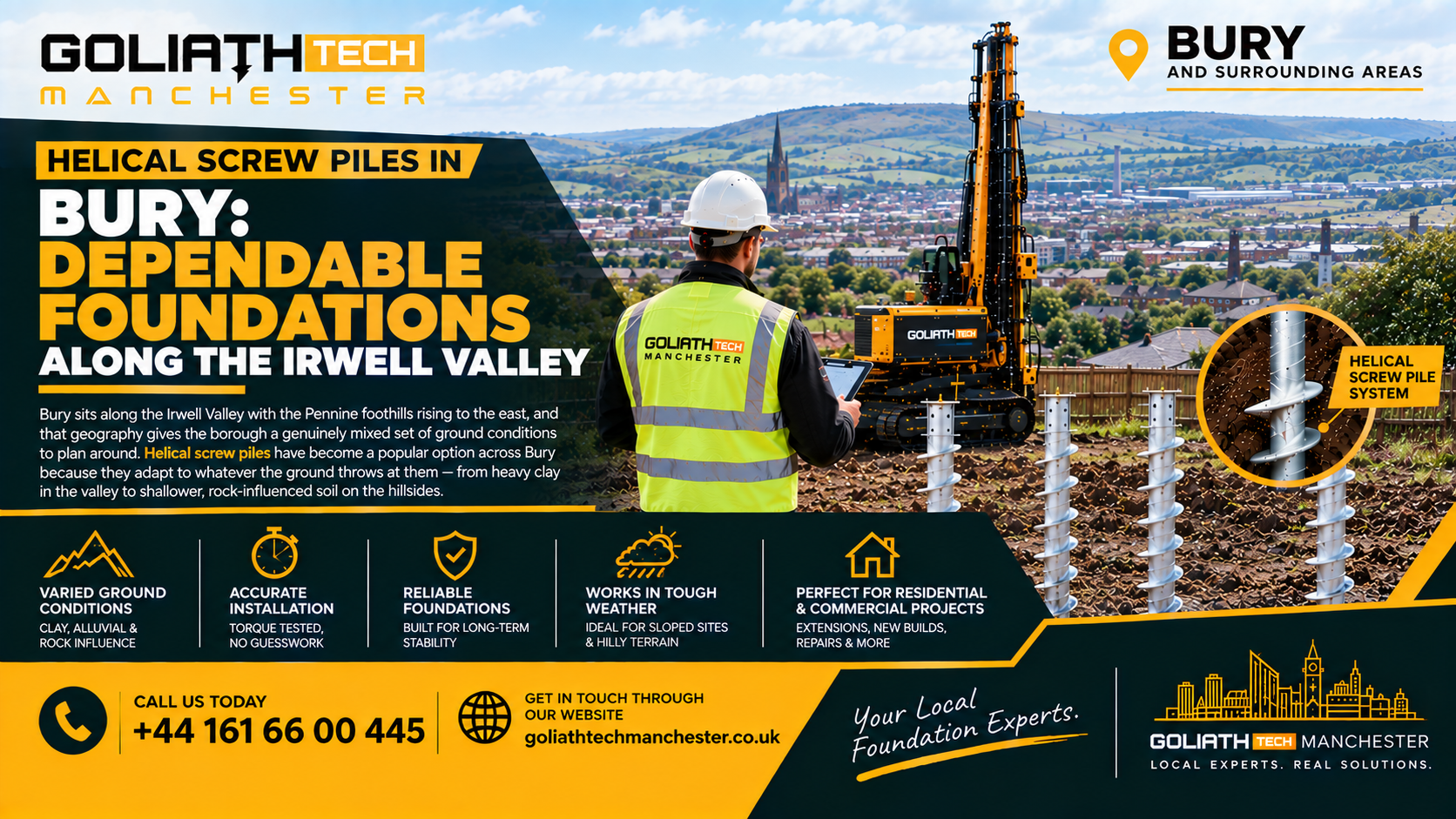
Bury sits along the Irwell Valley with the Pennine foothills rising to the east, and that geography gives the borough a genuinely mixed set of ground conditions to plan around. From the flatter, clay-heavy ground near the river to the steeper, more exposed sites out towards Ramsbottom and Tottington, foundation requirements can shift considerably within a few miles. This variation is a key reason helical screw piles in Bury have become such a popular option across the borough.
Bury’s Valley and Hillside Ground
The lower parts of Bury, closer to the Irwell and its tributaries, tend to have heavier clay and alluvial soil that holds moisture and can shift seasonally, a common challenge for shallow concrete foundations that weren’t designed with that movement in mind. Move further out towards Ramsbottom, Tottington, and the edge of the West Pennine Moors, and the ground changes again, becoming shallower over rock in places, with steeper plots that complicate standard groundworks access.
Bury’s mill town history also means a fair amount of older housing stock sits on made ground or shallow historic footings that were never intended to support anything beyond the original structure.
Why a Flexible Foundation Approach Suits Bury
Helical screw piles are installed to a depth confirmed by torque testing at each individual pile location, which means the foundation naturally adapts to whichever ground conditions a specific site presents, whether that’s the heavier clay near the valley floor or the shallower rock-influenced soil higher up towards Ramsbottom. There’s no need to guess at a uniform depth across an entire plot when the ground itself can vary considerably within it.
This adaptability also extends to access. Steeper, hillside plots around the edges of Bury borough are often difficult for standard concrete delivery and heavy groundworks equipment to reach, whereas the more compact machinery used for screw pile installation can generally get in without the same level of site preparation.
What We’re Seeing Across Bury
Most of our work in Bury involves home extensions and garden rooms in the town’s residential areas, along with a good number of projects out towards Ramsbottom and Tottington where sloped access and variable ground make screw piles a particularly sensible choice. We’re also seeing steady interest in foundation repair work on older properties near the valley floor showing signs of clay-related movement.
Conclusion

If you’re planning a build anywhere in Bury, from the valley floor to the hillsides towards Ramsbottom, it’s worth having your specific plot assessed properly rather than assuming a standard foundation will suit the ground. GoliathTech Manchester carries out free site assessments across Bury and can tell you clearly whether a screw pile foundation is right for your project.
Call us on +44 161 66 00 445 or get in touch through our website to book yours.