
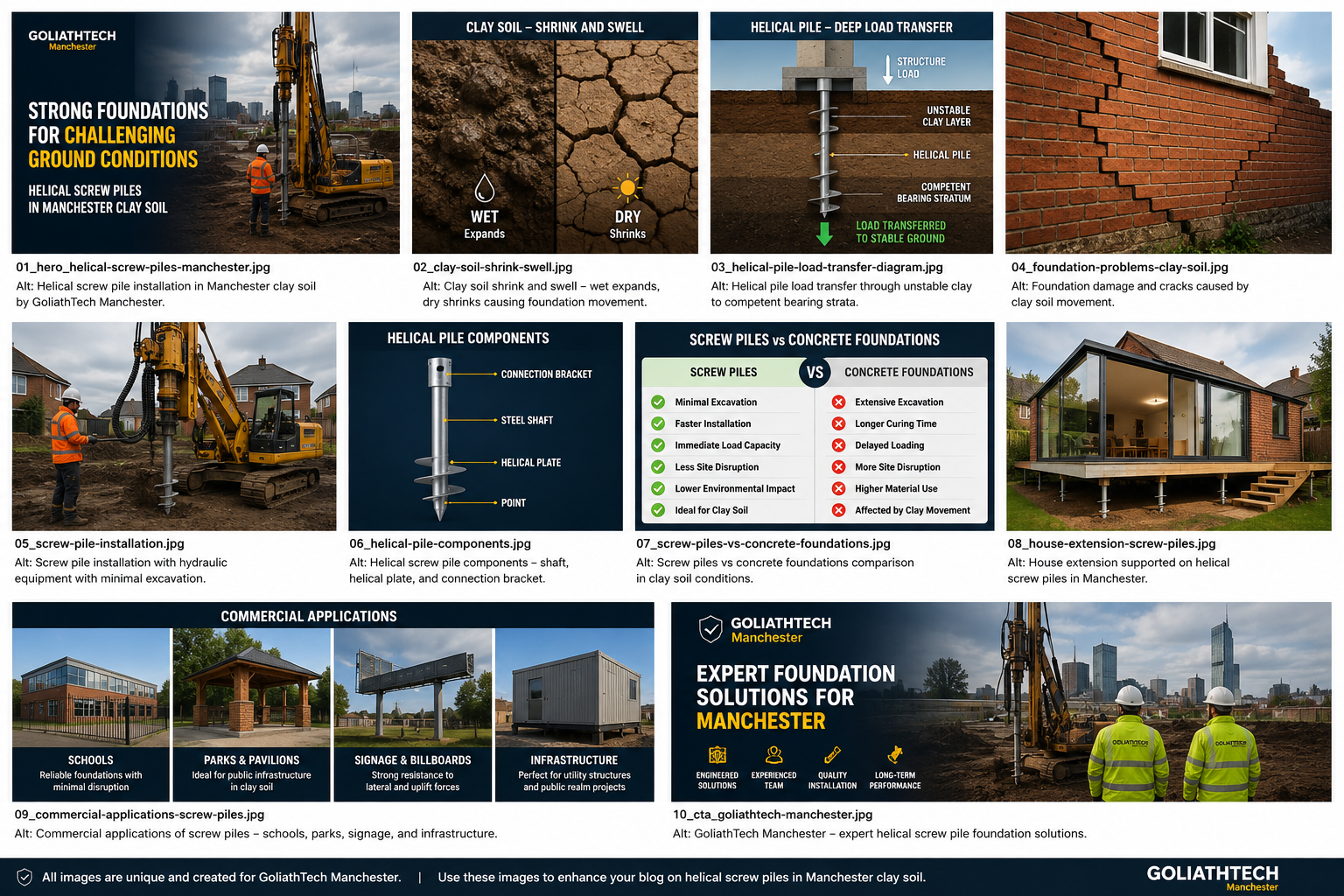
Building in Manchester, Greater Manchester, or the North? Clay soil is common across the region. It can cause problems for foundations if not managed correctly. That is why choosing the right foundation solution is important. It is a common problem in Manchester, Greater Manchester, up north and for good reason. Wet clay can expand, and dry clay can shrink and exert a lot of force on conventional foundations.
That often leads people to ask, “Can we install helical screw piles in Manchester clay soil?”
Yes, Manchester’s clay soil can create foundation challenges. Helical screw piles help overcome these issues. That is why they are often the recommended foundation solution.
The concrete footings rely on the shallow ground to support the structure. Screw piles are screwed deep down into the soil to reach more stable bearing layers in the ground. This helps reduce the effects of seasonal ground movement. It also provides a strong and reliable foundation for many types of structures.
Planning an extension, new home, or commercial development in Manchester, Greater Manchester, or the North? If so, it’s important to understand how clay soil can affect foundations. Clay ground conditions can influence foundation design and long-term performance. In this guide, we explain the challenges of building on clay soil. We also explain how helical screw piles can help. That is why they are becoming a popular foundation solution across Manchester, Greater Manchester, and up north.
What Is Clay Soil?
Clay soil consists of extremely fine mineral particles that retain water efficiently.
Characteristics include:
- High moisture retention
- Low permeability
- Significant expansion when wet
- Shrinkage when dry
- Seasonal movement
- High plasticity
Some clay soils are known as expansive clay or shrink-swell clay. They tend to vary dramatically in volume as moisture conditions change.
This movement is one of the leading causes of foundation damage in the UK.
Are Helical Screw Piles Suitable for Manchester Clay Soil?
Yes. Screw piles can be installed in Manchester clay soil and are often recommended. Where shrink-swell clay, poor ground conditions, limited access, or foundation movement concerns exist.
Properly engineered screw piles:
- Bypass unstable surface clay.
- Transfer loads to deeper, competent strata.
- Less digging needed.
- Minimize disruption.
- Offers immediate load-carrying capability.
- Replace concrete foundations with a sustainable option.
The key is proper site assessment, foundation engineering, and installation by experienced specialists.
How Clay Soil Affects Buildings and Extensions
Clay movement can create several structural problems.
Common Foundation Issues
- Differential Settlement
Different parts of a building move at different rates.
This may cause:
- Cracked brickwork
- Sticking doors
- Uneven floors
- Structural distortion
- Seasonal Ground Movement
Clay expands during wet weather and contracts during drought conditions. This repeated cycle places stress on foundations.
- Tree Root Influence
Big trees can draw a lot of moisture from clay soil.
This often leads to:
- Ground shrinkage
- Subsidence
- Foundation movement
- Extension Movement
House extensions can be especially vulnerable to ground movement. This is because new foundations may behave differently from the original structure.
Why Helical Screw Piles Perform Well in Clay Ground Conditions
Several engineering advantages make screw piles highly suitable for clay-rich sites.
Deep Load Transfer
Loads are transferred beneath the active moisture zone. This reduces the impact of seasonal clay movement.
Minimal Excavation
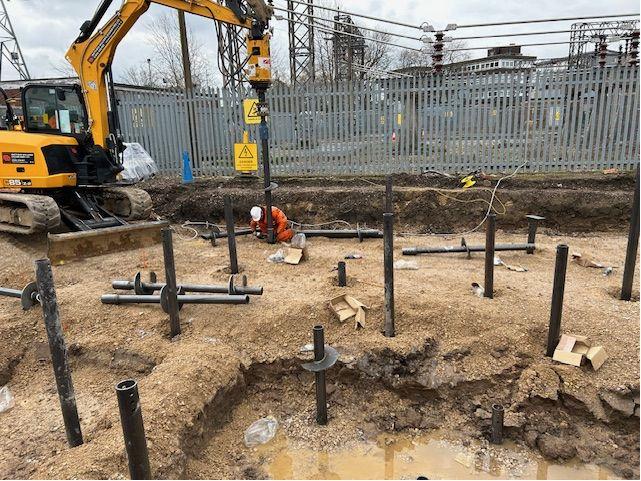
Traditional foundations require extensive digging. Screw piles involve very little excavation work.
Benefits include:
- Reduced spoil removal
- Faster installation
- Less site disruption
Immediate Load Capacity
Concrete foundations often require curing time. Screw piles can support loads immediately after installation.
Installation Verification
Engineers can monitor installation pressure. This provides real-time confirmation of foundation performance.
How Helical Piles Work in Expansive Clay
Helical piles consist of:
- A steel shaft
- One or more helical plates
- Engineered connection components
- Corrosion protection systems
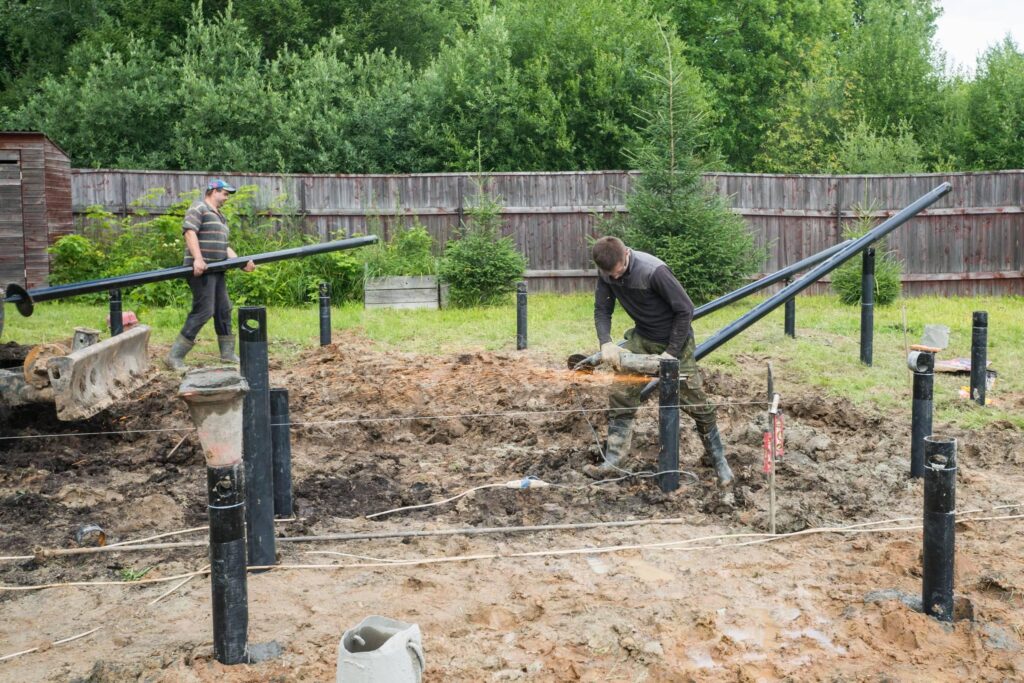
The helical screw pile rotates into the ground using hydraulic equipment.
As installation continues:
- Helices penetrate the clay.
- Soil disturbance remains minimal.
- Deeper competent layers are reached.
- Load-bearing capacity increases.
- Design torque is verified.
The result is a deep foundation system largely isolated from seasonal surface clay movement. Studies on cohesive soils have indicated that the helix configuration, spacing, and embedment depth are very important to achieve optimum performance.
Helical Screw Piles Vs Traditional Concrete Foundation In Clay Soil
When building on Manchester’s clay soil. Screw piles can often have clear advantages over traditional concrete foundations.
- Less digging. Shorter build time. Less mess.
- No big concrete footings: A more sustainable option with less material use.
- Faster Installation Screw piles can usually be loaded immediately with concrete needing to cure.
- Better performance in clay soil: They transfer loads deeper below the active shrink-swell zone. It helps to reduce the risk of movement.
- For restricted access sites: Perfect for house extensions, garden rooms, and town developments where space is at a premium.
- Less impact on the environment, Less waste, less digging, smaller carbon footprint.
Screw piles are a quick and clean foundation for many residential and commercial projects in Manchester. GoliathTech Manchester offers a reliable solution for difficult clay ground conditions.
Benefits of Screw Piles in Manchester Clay Soil
- Reduced Risk of Clay Movement
Deep installation avoids many shrink-swell issues.
- Faster Construction
Projects progress without waiting for concrete curing.
- Lower Environmental Impact
An excellent alternative to concrete foundations.
- Cleaner Sites
Minimal excavation means less mess.
- Year-Round Installation
Good for most weather conditions.
- Adaptability
It is a good usage for residential, commercial, and municipal applications.
Residential Applications
House Extension Foundations Manchester
House extensions often face challenges when matching new foundations to existing structures.
Screw piles provide:
- Reduced excavation
- Minimal disruption
- Reliable support
- Faster project timelines
They are particularly useful where clay movement has previously caused foundation concerns.
Garden Rooms
Garden rooms frequently require foundations in areas with difficult access. No large excavation equipment is required for screw piles.
Decks benefit from:
- Fast installation
- Precise positioning
- Long-term stability
Garages
Garages built on clay soil often benefit from engineered pile foundations. It reduces future movement risks.
Commercial Applications
Schools
School projects often require:
- Minimal disruption
- Tight construction schedules
- Sustainable construction methods
Screw piles satisfy all three requirements.
Parks
Public Park infrastructure frequently uses helical piles for:
- Pavilions
- Walkways
- Lighting systems
- Recreational structures
Signage
Signage and billboard foundations require strong resistance to overturning forces.
Helical piles are widely used for these applications because they provide excellent axial and lateral support.
Infrastructure
Applications include:
- Utility structures
- Modular buildings
- Transport-related installations
- Public realm projects
Common Mistakes When Building on Clay Soil
Ignoring the soil conditions
Each site is different.
Never miss ground investigations.
Shallow Foundations Without Assessment
What works at one site does not work at another.
Underestimating the Impact of Trees
Trees greatly affect the moisture content of clay.
Selecting Foundations Based on Cost
The most inexpensive foundation isn’t always the most inexpensive over the long term.
Not Consulting with Foundation Specialists
You could avoid expensive repairs later on with professional engineering input.
Expert Advice from Foundation Specialists
Building on Clay Soil in Manchester:
- Start With Site Survey
Know soil conditions before designing foundations.
- Consider Long-Term Ground Movement
What’s in season?
- Choose Engineered Solutions
All foundations should be adapted to the site conditions.
- Think Beyond the First Build Cost
The most important factor is lifecycle performance, not saving a few dollars in the short term.
- Work with Senior Professionals
The quality of design is as important as the quality of installation.
GoliathTech Manchester is an engineered helical pile systems company built for local ground conditions. Their solutions are deployed across Manchester and Greater Manchester. Helical piles have immediate load-bearing capacity. They also reduce site disturbance and contribute to long-term structural performance.
FAQ
Are screw piles good for clay?
Yes. Screw piles are often used in clay soil and can work very well if engineered properly.
Are screw piles good in expansive clay?
Yes, they are often designed to be bypassed by active shrink-swell zones.
Can house extensions be supported by screw piles?
Yes. They are used extensively for extension foundations throughout the UK.
Are concrete foundations better than screw piles?
Depending on the site conditions, screw piles have many advantages in many clay soil situations.
What is the depth of installation of screw piles?
Depth depends on the soil and on the uses to which the engineering is put.
Do screw piles need concrete?
Most screw pile installations do not require traditional concrete footings.
Conclusion
And you can put screw piles in Manchester clay soil? Yes.
Helical piles are often an excellent foundation solution for clay soil. They transfer loads below the active clay layer. This lowers the risk of ground movement and settlement.
Screw piles are a quick and reliable foundation solution. They can be used for house extensions, commercial buildings, and public infrastructure projects. When properly designed and installed, they provide long-term performance.
Speak With GoliathTech Manchester
Do you have a project in mind on clay soil in Manchester or Greater Manchester?
Screw piles and helical piles are a specialty of GoliathTech Manchester. The team provides foundation solutions for both residential and commercial projects.
Need expert advice? Contact GoliathTech Manchester to discuss your site conditions. Find the right foundation system for your project.